ADHD or trauma? Maybe you can't focus, you're restless, you forget things, and you've been told you probably have ADHD. Or maybe you've started to wonder if what looks like ADHD is actually your nervous system still bracing from something that happened a long time ago. Both of those questions are fair, and you're not confused or dramatic for asking them.
Here's the short answer. ADHD and trauma can look remarkably alike, and they can also exist together. Trouble concentrating, feeling on edge, difficulty with sleep, and emotional overwhelm show up in both. What differs is usually the why underneath, and the why is exactly what a careful look at your history is meant to find.

Why the Two Get Mistaken for Each Other
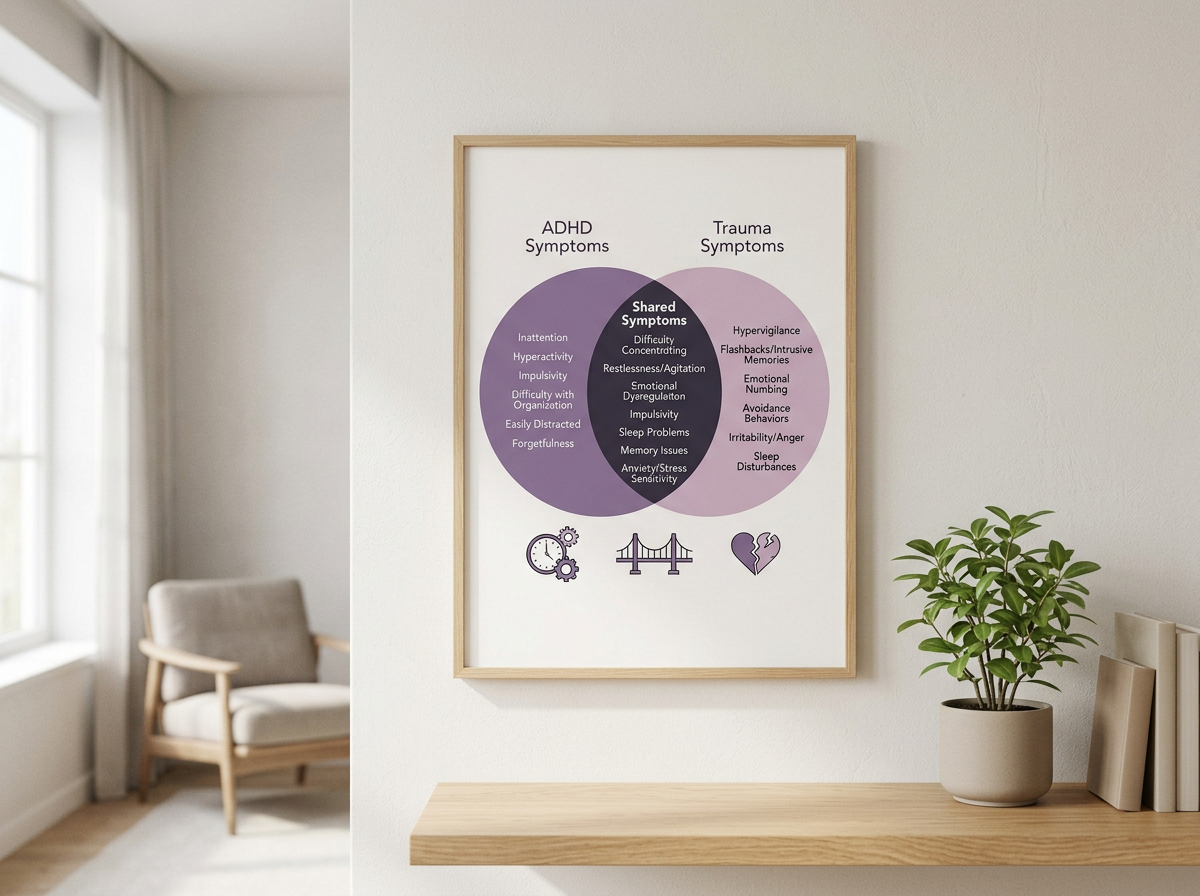
Both ADHD and trauma affect attention, energy, and how your brain handles stress. That's why so many of the day-to-day struggles look the same from the outside. A few of the shared ones:
Trouble concentrating or staying on one task
Restlessness, fidgeting, or feeling unable to sit still
Forgetfulness or losing track of things
Irritability and a short fuse
Feeling overwhelmed by everyday demands
Difficulty falling or staying asleep
Trouble starting or finishing tasks
The CHADD article "ADHD, PTSD, or Both?" by Michelle Ferrer, PhD, describes this same overlap, pointing to executive functioning trouble and restlessness as shared features. It also notes that intrusive memories and flashbacks are what tend to set PTSD apart. That piece focuses on children, but the basic idea carries into adulthood.
The Same Moment, Two Different Stories
One of the most helpful ways to tell these apart is to look at what's happening inside the moment, instead of just the behavior. Here are a few everyday examples:
You can't focus in a meeting. With ADHD, it may be that the content is boring or doesn't hold your interest, and your mind drifts to something more stimulating. With trauma, your attention may be pulled toward scanning the room, noticing who's tense, or waiting for something to go wrong.
You leave a room suddenly. With ADHD, it may be that you couldn't sit through a long, seated task anymore. With trauma, it may be a loud noise, a raised voice, or a feeling of being cornered that your body reacted to before your mind caught up.
You can't start something that matters. With ADHD, it's often that the task feels shapeless, and getting going is the hard part. With trauma, it can be that the task carries fear or a sense of danger, or your system is simply too depleted from staying on guard.
You snap at someone you love. With ADHD, it may come from frustration or overload, and fade quickly. With trauma, it may come from a trigger that your body read as a threat, and it can leave you feeling ashamed and shaken afterward.
These aren't rules, and plenty of people have a bit of both in each example. But noticing what's under the behavior is often the first useful clue.
The Timeline Clue
Another question clinicians often ask is when it started. ADHD is a neurodevelopmental condition, so its patterns typically show up early in life and stay fairly consistent across settings. Trauma-related symptoms often begin, or get dramatically worse, after a frightening, overwhelming, or painful experience, or after a long stretch of stress.
It's not always a clean line, though. If you grew up in an unsafe or unpredictable home, trauma may have started in early childhood, which can make it hard to separate from ADHD, even for professionals. The CHADD article makes the same point, noting that exposure to violence early in life can make the timeline hard to assess. So please don't feel like you're doing it wrong if the story is tangled.
What Your Body Might Be Telling You
A few experiences lean more toward trauma, and they're worth paying attention to:
Jumpiness or a strong startle response to sudden sounds or touch
Intrusive memories, nightmares, or flashbacks
Feeling constantly on guard, even in safe situations
Avoiding certain people, places, or reminders
Feeling numb, detached, or far away from yourself or your life
And a few lean more toward ADHD:
Losing track of time or struggling to estimate how long things will take
Being able to hyperfocus on something you love, but not on things you don't
Impulsive decisions or interrupting without meaning to
A lifelong pattern of disorganization, going back to childhood
If you recognize yourself on both lists, that's not a contradiction. It's very common, and it deserves a closer look instead of a quick label.
Why Not Both?
Sometimes it really is both. The CHADD article notes that estimates of ADHD and PTSD occurring together range from roughly 12% to 37% across the lifespan, which is a wide range but a meaningful one. Having ADHD can make a person more likely to experience difficult events, and trauma can make attention and focus even harder.
It also works the other way. Early adversity can change how the brain handles stress, and in some cases trauma gets mistaken for ADHD. Either way, you're not failing at sorting yourself out. This is genuinely hard to untangle on your own.
Why Getting the Right Answer Matters
It's tempting to just grab the label that fits and move on, but the support for each is different. ADHD often calls for strategies, structure, and sometimes medication, decisions that belong with a qualified prescriber. Trauma often calls for therapy that addresses the experiences underneath. If trauma is treated like ADHD, the real source can go untouched. If ADHD is treated like trauma, you may be left without the tools you need.
It's also worth ruling out other things that can mimic both, like thyroid problems, sleep disorders, anxiety, or depression. A visit to your doctor is a reasonable first step if you haven't had one in a while.
What a Careful Look Includes
A good assessment doesn't rely on a checklist alone. It usually involves a detailed history of your life from childhood on, a look at when symptoms started and what was going on around them, and attention to how you function in different settings. It asks what you feel inside, not just what others see. And it stays open to the possibility that more than one thing is going on.
If you're also wondering about autism, which overlaps with both, I offer adult autism evaluations here in Pensacola. And if the trauma side is what you want to explore, that's the part I can help you sort through.
Where EMDR Fits, and What It Doesn't Do
EMDR, which stands for Eye Movement Desensitization and Reprocessing, is a structured therapy that helps your brain reprocess distressing experiences so they stop feeling so current. The EMDR International Association describes it as moving through eight phases, from history-taking and preparation to reprocessing and closure.
I want to be clear about the limits. EMDR has its strongest research for PTSD, and it isn't a treatment for ADHD itself. What it can do is work on the trauma-driven part of the picture. If some of your restlessness, overwhelm, or trouble focusing comes from a nervous system that never got the message that the danger is over, working on those experiences can help that part settle. Any ADHD-related needs would be addressed separately, alongside it.
You also don't have to retell every painful detail. The VA's National Center for PTSD notes that clients generally aren't required to describe the trauma in detail during EMDR. We go at a pace that feels safe, and you're always allowed to pause.

A Few Things to Notice This Week
If you're trying to make sense of your own pattern, a little observation can go a long way. Without judging yourself, try noticing:
When your focus drops, is it from boredom, or from something that feels like tension or threat?
Do your symptoms get worse around certain people, places, sounds, or reminders?
Were these patterns there as far back as you can remember, or did they change after something happened?
What helps in the moment: interest and novelty, or safety and calm?
Jot down what you see, even in a few words. It gives whoever you end up talking to a much clearer picture, and it helps you trust your own experience.
You Don't Have to Sort It Out Alone
If you've spent years wondering why your mind works the way it does, please hear me. You're not lazy, and you're not broken. There's usually a reason, and finding it is a relief. Whether it turns out to be ADHD, trauma, both, or something else, you deserve support that fits what's actually going on.
I offer weekly EMDR and focused EMDR intensives, in person in Pensacola and virtually across Florida and Alabama. No pressure. Just clarity. I'm here to help along the way!
About the Author

Hannah Ciampini, LCSW, is a trauma therapist and owner of Hello Calm Therapy in Pensacola, Florida, and she specializes in EMDR and Brainspotting intensive therapy for adults working through childhood trauma, anxiety, and patterns that continue to feel stuck despite previous therapy or insight. Hannah offers in-person EMDR intensives in Pensacola and virtual intensive therapy for clients located in Florida and Alabama.