What Does EMDR Stand For? Breaking Down the Process Step by Step
If you've seen the word EMDR somewhere online and thought, okay, but what does that actually stand for, you're in the right place. It's one of the first questions almost everyone asks me, usually before anything else about how therapy actually works.
EMDR /ˈiː-em-diː-ɑːr/
noun, also used as a verb (“to do EMDR”)
Short for Eye Movement Desensitization and Reprocessing. A structured form of psychotherapy that uses bilateral stimulation, most often guided eye movements, to help the brain reprocess distressing memories.
Breaking Down Each Letter
Here's what each part of the name actually refers to:
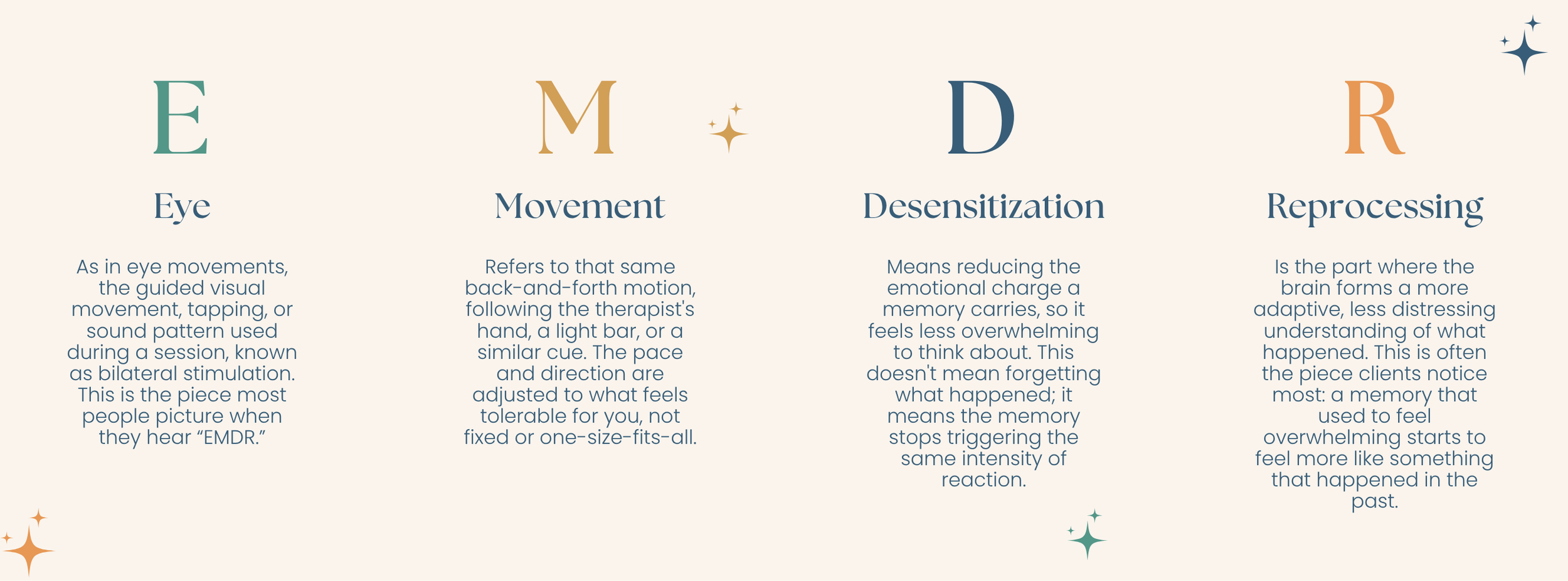
Common Terms You'll See Alongside EMDR
Once you start reading about EMDR, a few related terms tend to show up right alongside it. Here's a quick plain-English glossary:
Adaptive Information Processing (AIP): the theory behind EMDR, the idea that the brain has a natural system for processing experiences, and trauma can get this system “stuck.”
Target memory: the specific memory, image, or belief you and your therapist focus on during a session.
SUDS (Subjective Units of Disturbance Scale): a simple 0 to 10 scale you'll use to rate how distressing a memory feels before, during, and after processing.
Resourcing: building coping tools and a sense of internal stability before and during trauma processing, so you have something steady to return to.
None of these are terms you need to memorize before starting EMDR. They just tend to come up, so it helps to recognize them if your therapist uses them.
How Long Does EMDR Usually Take?
This varies a good deal depending on your history and goals. Some people notice a shift in how a specific memory feels after just a handful of sessions. More complex or longstanding trauma often takes longer, whether that's spread across weekly sessions over several months, or condensed into a focused intensive over a few days.
There isn't a universal timeline, and that's actually by design. EMDR is paced around your nervous system's capacity, not a fixed session count.

Where Did the Name Come From?
EMDR was developed by psychologist Francine Shapiro in 1987. As the story goes, she noticed that certain eye movements seemed to reduce the intensity of her own distressing thoughts during a walk, and she went on to study and refine that observation into the structured therapy used today.
I like sharing that with clients, honestly, because it takes some of the mystery out of it. This isn't an ancient practice or a trend. It's a specific, researched method with a fairly traceable origin story.
What Does “Bilateral Stimulation” Mean?
Bilateral stimulation means alternating stimulation on both sides of the body, most commonly through side-to-side eye movements, but sometimes through alternating taps or tones instead.
It's the mechanism underneath the “eye movement” part of EMDR's name, and it's what your therapist is guiding when they move their hand back and forth or use a light bar during a session.

Is EMDR the Same as Hypnosis?
No. EMDR is not hypnosis. You remain fully awake, aware, and in control throughout the entire session. This is one of the most common misunderstandings I hear, usually from people who've only seen EMDR described secondhand.
Unlike hypnosis, you're not being put into a trance or having suggestions planted. You're actively participating, checking in with your therapist between each set of eye movements.
Quick Fact
The “eye movement” part of the name is actually the most visible piece of EMDR, but not the only form it takes. Some therapists use tapping or alternating tones instead, depending on what works best for the client.
EMDR by the Numbers
Sometimes a handful of numbers explain something faster than a paragraph can. Here's EMDR at a glance:
1987
Year EMDR was developed
8
Phases in a full treatment plan
1–3
Typical days in an EMDR intensive
30+
Years of clinical research behind it
That last number matters more than it might seem. EMDR isn't a new or untested idea; it's had decades to be studied, refined, and used by therapists around the world.
EMDR Intensives vs. Weekly Therapy: What's Actually Different
The word “intensive” isn't part of what EMDR stands for. It describes the format the therapy is delivered in, and that format makes a real difference in how the work feels and progresses.
Session length: weekly EMDR typically runs in standard 50-minute sessions. An intensive condenses several hours of protected therapy time into a single day or a short block of consecutive days.
Pacing: weekly sessions space processing out over weeks or months, with time in between to integrate. Intensives move through that same processing in a much shorter window, with less time between sessions to “come up for air.”
Focus: weekly therapy often blends trauma processing with general life support and check-ins. An intensive is built around one specific goal, usually processing a particular memory, event, or pattern.
Best fit for: weekly EMDR tends to suit people who want trauma work folded into ongoing, general support. Intensives tend to suit people who already have a clear focus, want faster momentum, or are traveling in from outside the area specifically for focused treatment.
Neither format is more “real” EMDR than the other. The underlying therapy is identical either way, only the pacing changes.
In Short
EMDR stands for Eye Movement Desensitization and Reprocessing
It was developed by psychologist Francine Shapiro in 1987
Bilateral stimulation is the underlying mechanism, most often eye movements
EMDR is not hypnosis, you stay fully aware throughout
Weekly EMDR and EMDR intensives use the same therapy, just paced differently
Frequently Asked Questions
What does EMDR stand for?
EMDR stands for Eye Movement Desensitization and Reprocessing, a structured therapy that uses bilateral stimulation to help the brain reprocess distressing memories.
What is the EMDR meaning in therapy specifically?
In a therapy context, EMDR refers to both the acronym and the treatment method itself: a therapist-guided process combining bilateral stimulation with memory processing to reduce the distress connected to a specific experience.
Who invented EMDR?
EMDR was developed by psychologist Francine Shapiro in 1987, after she observed that certain eye movements appeared to reduce the intensity of her own distressing thoughts.
Is EMDR the same thing as talk therapy?
No. Talk therapy relies primarily on verbal discussion and insight. EMDR incorporates bilateral stimulation to directly target how a distressing memory is stored, which is a different mechanism than talk therapy alone.
How many sessions of EMDR does it usually take?
It depends on the complexity of what's being processed. Some people notice a shift after a few sessions, while more complex or longstanding trauma may take longer, whether spread across weekly sessions or condensed into a focused intensive
Curious Whether EMDR Could Help You?
Now that you know what the letters actually mean, the next natural question is usually whether it's a fit for what you're carrying. That's a conversation, not something you have to figure out alone from a blog post.
I'm Hannah Ciampini, LCSW, owner of Hello Calm Therapy in Pensacola, Florida. I specialize in focused EMDR and Brainspotting intensive therapy for adults working through trauma, anxiety, childhood experiences, medical trauma, religious trauma, and patterns that still feel stuck despite insight or previous therapy.
I offer in-person EMDR intensives in Pensacola as well as virtual intensive therapy for clients located in Florida and Alabama. Clients may also travel to Pensacola for focused intensive work.

About the Author
Hannah Ciampini, LCSW, is a trauma therapist and owner of Hello Calm Therapy in Pensacola, Florida. She specializes in EMDR and Brainspotting intensive therapy for adults working through childhood trauma, complex trauma, anxiety, medical trauma, religious trauma, and patterns that continue to feel stuck despite previous therapy or insight.
Hannah provides in-person EMDR intensives in Pensacola and virtual intensive therapy for clients located in Florida and Alabama. She also works with clients who travel to Pensacola for focused intensive trauma therapy.